
Updated August 30, 2026 · By Sumbat.T
Windows Voice Typing: How Win+H Works and When to Replace It

The short answer
- Press Win + H with your cursor in a text box. The voice typing bar appears, you speak, and the words are typed where your cursor is. It works the same way on Windows 10 and Windows 11, it is free, and there is nothing to install.
- It needs an internet connection. Microsoft documents this directly: you need to be connected to the internet, have a working microphone, and have your cursor in a text box. Voice typing is cloud based, so it stops working the moment your connection drops.
- It transcribes, and that is the whole job. You get auto punctuation and a fixed list of spoken commands. You do not get a custom dictionary, paragraph structure, formatting, or any way to add a command of your own.
- If those limits are the ones you keep hitting, that is the gap a dedicated dictation app fills. BlabbyAI runs on Whisper large v3 turbo, types into any Windows text field on Ctrl + Space, learns spellings you define, and reshapes what you said into an email or clean notes in the same keystroke. Free tier, no card.
Dictation that arrives finished





Stop cleaning up after your dictation
BlabbyAI types into any Windows app on Ctrl+Space, spells your vocabulary the way you taught it, and formats the text before it lands. 60 free credits a week, no card.
What Windows voice typing actually is
Windows voice typing is the dictation tool built into Windows 10 and Windows 11. Put your cursor in a text box, press the Windows logo key and H together, and a small bar appears near the bottom of your screen. Once it says it is listening, whatever you say is typed into the field your cursor was in. There is no account, no installation, and no configuration step. For a feature most people discover by accident, it is remarkably good at the narrow thing it does.
The naming has been a mess, which is why so many people are unsure whether they have it. Windows 10 called this feature Dictation. Windows 11 calls the same feature voice typing. Microsoft's own privacy documentation states the change plainly: in Windows 11, Dictation is called voice typing. They are not two tools, they are one tool with two names, and Win + H opens it in both.

The voice typing bar on Win+H. Free, always there, and the words arrive exactly as spoken.
Where the confusion gets expensive is the third tool. Windows also ships voice access, an accessibility feature opened with Win + Ctrl + S, which controls the entire computer by voice as well as dictating. Voice access replaced the old Windows Speech Recognition on Windows 11 22H2 and later. The three get recommended interchangeably in forum answers, and they behave very differently. The most important difference is that voice access runs on your device and works offline, while voice typing does not.
The distinction that matters most
Voice typing (Win + H) is cloud based and stops working without internet. Voice access (Win + Ctrl + S) runs on-device and keeps working. If you dictate on a train or a plane, that single line decides which tool you should be using.
How to use voice typing, step by step
The whole sequence takes about four seconds once you know it. The order matters more than people expect, because the first step is the one that most often causes the shortcut to appear broken.
- Click into a text box first. A Word document, an email body, a browser search field, anything you can type in. Windows will not open the voice typing bar unless it has somewhere to put the text, which is the single most common reason Win + H seems to do nothing.
- Press Win + H. The voice typing bar appears. On a touchscreen you can instead tap the microphone key on the on-screen touch keyboard.
- Wait for it to say it is listening. Speaking before the bar is ready is why the first word of a sentence often goes missing, or occasionally gets typed twice.
- Speak normally. Do not slow down or over-enunciate. Modern recognition handles a natural pace better than a careful one, and exaggerated speech tends to make accuracy worse rather than better.
- Say "stop listening" when you are done, or click the microphone button on the bar.
Turn on automatic punctuation while you are there. The gear icon on the voice typing bar opens its settings, and auto punctuation inserts commas and full stops based on your phrasing and pauses. Without it you have to say every punctuation mark out loud, which is exhausting over anything longer than a sentence or two.
The commands, and the limit built into them
Voice typing understands a set of spoken commands published by Microsoft. The useful ones in practice are "stop listening", "delete that", "select that", "press Enter" and "undo that", alongside spoken punctuation where you say "comma" or "period" and get the mark. They work reliably and they are worth learning.
The limit is that the list is fixed, in two ways that both bite. You cannot add a phrase of your own, so if the wording that comes naturally to you is not on Microsoft's list, it is typed out as literal text in the middle of your document. Anyone who has said "new paragraph" into voice typing and watched the words new paragraph appear in their email knows the feeling. And command coverage varies by language, with English served best and other languages considerably thinner.
Why this one limit matters more than it looks
Dictation is a habit, and habits are personal. The phrase you reach for when you want a line break is not necessarily the phrase Microsoft chose. A fixed vocabulary means you adapt to the tool. A vocabulary you write yourself means the tool adapts to you, which is the difference between dictation you use twice and dictation you use all day.
When Win+H does nothing: the actual causes
"Windows voice typing not working" is one of the most searched phrases attached to this feature, and the causes cluster into a short list. Work down it in order, because the first two account for most cases.
No text field has focus
Win+H only opens when Windows has somewhere to type. Click into a document or a search box and press it again. This is the single most common cause and it looks exactly like a broken shortcut.
No internet connection
Voice typing is cloud based. The bar may open and then simply never produce words. Voice access, which runs on-device, is the built-in option that survives this.
Wrong microphone selected
If the bar opens and stays silent, Windows is usually listening to the wrong device. Check Settings, System, Sound, and confirm the default input is the microphone you are speaking into.
Microphone access is blocked
Under Settings, Privacy and security, Microphone, both the system-wide toggle and desktop app access need to be on.
A remote session is intercepting it
Remote desktop and virtual machine sessions frequently swallow the shortcut before Windows sees it. The same keystroke on the host machine works fine.
The app draws its own text fields
Some older desktop software and locked-down enterprise apps do not report focus in the way Win+H expects, so it fails in that one app while working everywhere else.
There is also a category of problem that no configuration change fixes: Windows updates have broken the shortcut outright on occasion, and the voice typing launcher setting has a long-standing habit of not persisting between sessions. If your voice typing was working last week and nothing about your setup changed, an update is a reasonable suspect. Our voice typing not working guide works through the fixes in more depth.
The five limits people actually hit
Voice typing is free and built in, and for a great many people that settles the question. The people who go looking for something else tend to arrive there through one of five specific frustrations rather than a general dissatisfaction. It is worth knowing which one is yours, because it decides whether a replacement is worth it at all.
| The limit | What it means in practice |
|---|---|
| Accuracy on names and jargon | General-purpose recognition with no knowledge of your vocabulary, and no way to teach it. |
| No custom dictionary | A term it spells wrong today it spells wrong every day. There is nowhere to correct it permanently. |
| Unstructured output | Auto punctuation, and nothing beyond it. No paragraphs, no lists, no headings, no change of tone. |
| A fixed command list | Say a phrase Microsoft did not ship and it gets typed out as text rather than obeyed. |
| Requires an internet connection | Microsoft documents this explicitly. On a plane or a dropped connection, voice typing stops entirely. |
The third one is the one that quietly costs the most time. Voice typing gives you a continuous stream of punctuated sentences, because that is what transcription is. If what you needed was an email with a greeting and three short paragraphs, or a set of notes as bullet points, you get the raw material and then you do the shaping yourself with the keyboard you were trying to avoid. The dictation was fast. The cleanup was not.
What BlabbyAI does about those five
BlabbyAI is a dictation app for Windows built around the assumption that transcription is the start of the job rather than the end of it. It runs on Whisper large v3 turbo, which closes most of the accuracy gap on names and technical vocabulary on its own, and it types into any Windows text field on Ctrl + Space, the same way Win+H does. There is no per-app integration to set up because there is nothing to integrate: if you can type into it, you can dictate into it.
The part that answers the formatting limit is custom modes. A mode is an instruction you write once that gets applied to everything you dictate while it is active. Your speech goes to the transcriber, the transcript goes to an AI model with your instruction attached, and the finished text is what lands in the field. It is the difference between dictating a draft and dictating the final thing.
What Win+H types
hey marcus quick update on the migration we finished the staging cutover last night everything came through clean the only thing outstanding is the dns switch which I want to do thursday morning when traffic is low let me know if that works
What an email mode types
Hi Marcus,
Quick update on the migration. We finished the staging cutover last night and everything came through clean.
The only item outstanding is the DNS switch. I would like to do that Thursday morning when traffic is low. Let me know if that works for you.
Thanks
Both columns are the same recording. The left is what a transcriber gives you, which is what Win+H gives you. The right is what arrives when a mode is doing the shaping, and it arrives directly in the message box with no second pass. The instruction behind it is a sentence in plain English, something like "format what I said as a short professional email with a greeting and paragraph breaks, and strip out filler words".
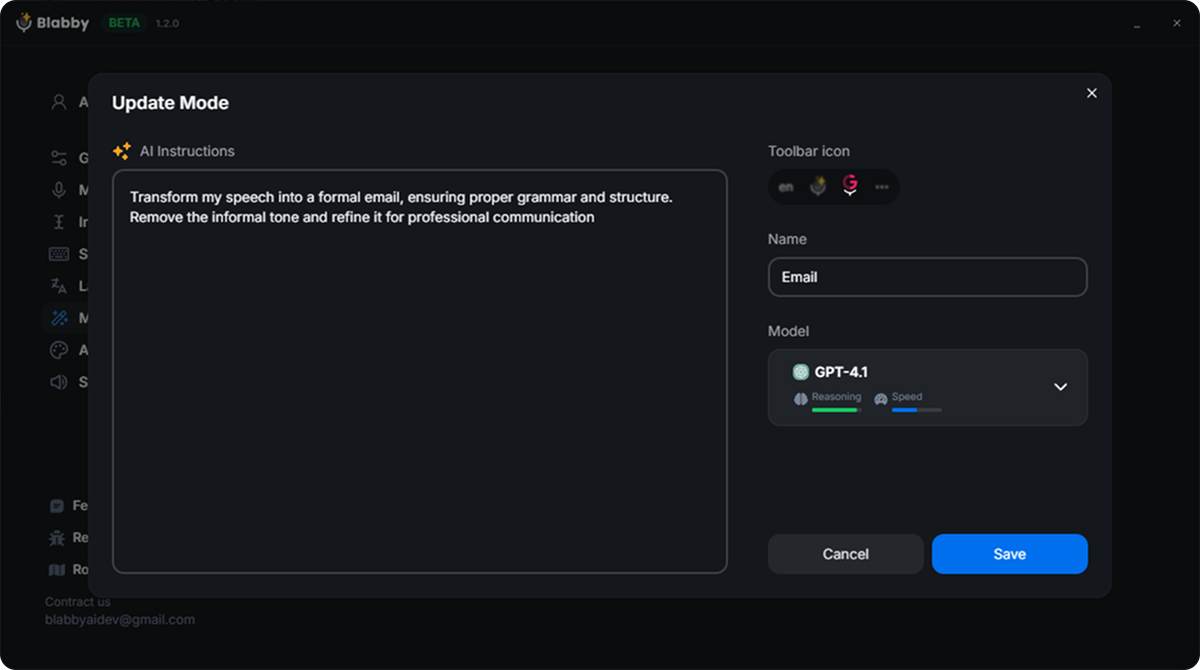
A mode is a plain-English instruction plus a model. Source: BlabbyAI.
The same mechanism solves the fixed-command-list problem, and it is worth understanding why, because it is not obvious. The AI receives the complete literal transcript, including any words you spoke as instructions. So you can write into a mode: whenever I say "new paragraph", insert an actual paragraph break instead of writing those words. Now "new paragraph" does what you mean. So does "bullet point", or "scratch that", or whatever phrasing you actually use, because you defined the vocabulary rather than learning someone else's.
For the dictionary limit there is custom spelling. In Settings, Languages, you add the spelling of a term exactly as you want it written, and the transcriber matches it from then on. Client names, drug names, internal product codenames, a colleague whose name has an unusual spelling: you fix it once instead of every single time.
History, on the Windows app
Audio is written to your disk the moment recording stops, before transcription even starts, so a dropped connection never costs you the recording. You can replay any past recording and run it through a different mode later.
90+ languages, auto-detected
Speak in one language and have a mode translate it into another before it is typed, with grammar cleaned up in the same pass. That is one keystroke for something that is otherwise three applications.
Windows, Android and Chrome
Three ways to run it, depending on your device
The Windows app types system-wide on Ctrl+Space and keeps local History. The Android app puts a floating mic in any text field on your phone. The Chrome extension needs no installation at all, which is the answer on a locked-down work laptop.
If you cannot install software: the Chrome extension
A large share of the people hitting the limits of Win+H are on machines they do not fully control. Managed corporate laptops, university lab machines, and locked-down enterprise environments all tend to block executable installs, which rules out most dictation software before the conversation about features even starts. Voice typing is often chosen by default in these environments simply because it is already there.
The BlabbyAI Chrome extension is the answer to that specific constraint. It installs from the Chrome Web Store with no executable and no administrator rights, and it shows a small bubble next to whatever text field you are focused on, with the same custom modes and custom spellings as the desktop app. Inside the browser, which for most knowledge work now means Gmail, Google Docs, Notion, Jira, Salesforce and every internal web tool, it does the same job.
It is also the option for anyone not on Windows at all. The extension runs wherever Chrome runs, which includes macOS and Chrome OS, so a Chromebook or a Mac gets the same dictation behaviour without a desktop application. The one feature it does not carry is History, which is specific to the desktop app. On a phone, the BlabbyAI Android app puts a small floating mic in any text field, on top of the keyboard you already use, and is free during the beta.
Windows voice typing compared with the alternatives
Two of the three options here are free and already installed on your machine, which is worth saying plainly. The table is not an argument that you should pay for dictation. It is a map of which tool covers which job, so you can tell whether the thing frustrating you is actually fixable.
| Tool | Price | Works offline | Custom vocabulary | Formatting |
|---|---|---|---|---|
 Windows voice typing (Win+H) Windows voice typing (Win+H) | Free, built in | No, needs internet | None | Auto punctuation only |
| Voice access | Free, built in | Yes, after setup | None | Auto punctuation only |
| BlabbyAI | Free tier, $8.49/mo unlimited | No, cloud based | Custom spellings you define | Custom modes reshape the text |
Read across the offline column and you have the clearest split in the set. If your requirement is dictation that works with no connection, voice access is the only one of the three that does it, and it is free. Read across the last two columns and you have the other split: the built-in tools transcribe, and a dedicated app shapes. Those are different products solving different halves of the same problem, and plenty of people sensibly use the free one for quick messages and something else for real writing.
Who should stay on Win+H, and who should not
If you dictate occasionally, mostly short messages, in a quiet room, on a machine with a stable connection, and the words that come out are close enough that fixing them takes seconds, voice typing is doing its job. It is free, it is already installed, and there is nothing to gain from replacing it.
The calculation changes when dictation becomes a daily working habit rather than an occasional convenience. At that volume the small frictions compound: the same three names misspelled every day, the paragraph breaks you insert by hand every time, the commands that type themselves out as text, the cleanup pass at the end of every long message. Each one costs seconds and none of them ever gets better, because there is no mechanism in voice typing for it to learn anything about you.
That is the honest dividing line. Voice typing is a good free transcriber with no memory and no opinions about formatting. If what you want is a transcriber, you already have a decent one. If what you want is finished text, that is a different tool, and BlabbyAI on Windows starts free with 60 credits a week and runs $8.49 a month for unlimited use.
Frequently asked questions
What is Windows voice typing?
Windows voice typing is the built-in dictation feature in Windows 10 and Windows 11 that converts your speech into text in whatever text box your cursor is in. You open it by pressing the Windows logo key and H together, then start speaking once the toolbar shows that it is listening. It is free, it ships with the operating system, and it needs no installation or account. Microsoft renamed the feature between versions, which causes some confusion: what Windows 10 called Dictation is what Windows 11 calls voice typing, and both are the same Win+H tool. It is separate from voice access, which is the accessibility tool for controlling the whole computer by voice.
What is the shortcut for voice typing in Windows?
The shortcut is the Windows logo key plus H, pressed together, on both Windows 10 and Windows 11. Your cursor has to be inside a text box first, because Windows only opens the voice typing bar when it has somewhere to put the text. On a touchscreen device you can also tap the microphone key on the on-screen touch keyboard. There is no way to change Win+H to a different key combination in Windows settings, which is a common request from people whose hands cannot comfortably reach that combination. Third-party dictation tools generally let you rebind the trigger: BlabbyAI defaults to Ctrl+Space and can be reassigned in its shortcut settings.
Does Windows voice typing work offline?
No. Microsoft states plainly in its own documentation that to use voice typing you will need to be connected to the internet, have a working microphone, and have your cursor in a text box. The audio is sent to Microsoft servers for recognition and the text comes back, so voice typing stops working entirely on a plane, on a dead hotel connection, or on a machine with restricted network access. This surprises people because voice access, the other Windows speech tool, does run on-device and does work offline once its language model has downloaded. The two get recommended interchangeably and they behave differently the moment your connection drops.
Why is Windows voice typing not working?
The most common causes, roughly in the order worth checking: no text field has focus, since Win+H will not open without somewhere to type; there is no internet connection, which voice typing requires; the microphone is not set as the default input device, or microphone access is switched off under Settings, Privacy and security, Microphone; or a remote desktop session is intercepting the shortcut before Windows sees it. Windows updates have also broken the shortcut on occasion, and there are recurring reports of the voice typing launcher setting failing to persist between sessions. If the toolbar opens but no words appear, the problem is almost always microphone selection rather than the feature itself.
Is Windows voice typing accurate?
It is reasonably accurate on clear, conversational speech in a quiet room, and noticeably weaker on proper nouns, technical vocabulary, industry jargon, and accented speech. The gap comes from what the model was built to do: voice typing is a general-purpose transcriber, and it has no knowledge of the names, product terms, or abbreviations specific to your work. There is also no way to teach it. Windows voice typing has no custom dictionary, so a name it gets wrong today it will get wrong every day. Dedicated dictation tools compete precisely on this: BlabbyAI runs on Whisper large v3 turbo and supports custom spellings, so you tell it once how a term is written and it matches that afterwards.
Can Windows voice typing add punctuation automatically?
Yes. Voice typing has an automatic punctuation setting, reachable through the gear icon on the voice typing bar, which inserts commas and full stops based on your pauses and phrasing. It is a genuinely useful feature and it works reasonably well on straightforward sentences. What it does not do is any structural formatting: it will not create paragraph breaks, bullet lists, headings, or numbered steps, and it will not adjust the register of what you said. You get a continuous run of punctuated sentences, which is fine for a chat message and awkward for anything longer that needs shape.
What voice commands does Windows voice typing support?
Microsoft publishes a fixed list, including stop listening, delete that, select that, press Enter, and undo that, along with spoken punctuation such as saying comma or period. The list is fixed in two senses that matter. You cannot add a phrase of your own, so if the wording you naturally say is not on the published list it gets typed out as literal text instead of being obeyed. And the command support varies by language, with the fullest coverage in English and thinner support elsewhere. Tools where you write your own command vocabulary work differently: in BlabbyAI you describe the commands you want in a mode instruction, so new paragraph or bullet point does what you mean because you defined it.
What is the difference between voice typing and voice access?
Voice typing does one job: speech into text, in the field your cursor is in, opened with Win+H. Voice access is the accessibility tool that controls the entire computer by voice, opened with Windows key plus Ctrl plus S, so you can say open Chrome, click Save, or show numbers to interact with on-screen elements, and it dictates as well. The practical differences are that voice access runs its recognition on your device and works offline once set up, while voice typing is cloud based and does not. If you only want to write with your voice, voice typing is simpler. If you cannot use a keyboard or mouse at all, voice access is the one built for that.
Is there a better alternative to Windows voice typing?
That depends on what is falling short. If voice typing works fine for you and you only dictate short messages, the built-in tool is free and there is no reason to replace it. The people who move on usually hit one of five limits: the accuracy gap on names and jargon, the lack of any custom dictionary, output that arrives as a wall of unstructured text, the fixed command list, and the hard requirement for an internet connection. BlabbyAI addresses the first four: Whisper large v3 turbo for accuracy, custom spellings you define, custom modes that reshape what you said into an email or bulleted notes in the same keystroke, and spoken commands you write yourself. It is free to start with 60 credits a week and $8.49 a month unlimited.
Does Windows voice typing work in every application?
Mostly, but not universally. Voice typing types into whatever standard Windows text field has focus, so it works across Word, Outlook, Chrome, Slack, Notion and the great majority of desktop and web applications. Where it fails is applications that draw their own text fields without reporting focus to Windows in the expected way, which tends to mean older desktop software, some remote desktop and virtual machine sessions, and certain locked-down enterprise applications. If Win+H opens but nothing appears when you speak into one specific app while working fine elsewhere, that is the cause. A browser-based dictation tool is often the practical workaround on managed machines where installing software is not permitted.
Related reading
If you want the full setup walkthrough for both Windows versions, our voice typing on Windows 11 guide covers activation and troubleshooting in depth. For what happened to the old speech engine, read Windows Speech Recognition and what replaced it. The voice typing shortcut keys reference lists what each combination does, and the best dictation software for Windows compares the paid options with real prices. For the wider category, see dictation software and speech to text.
Try it on a real day of your own typing
60 credits every week, no card and no account setup. Use it in the apps you already work in and see how much of the cleanup disappears.