
Published August 23, 2026 · Updated August 23, 2026 · By Sumbat.T
Dragon Medical One Pricing: What It Actually Costs in Year One
Microsoft does not publish a price for Dragon Medical One. Every number you find comes from a reseller, and they disagree. Here is the actual structure of the cost, the spread between sellers quoting the same product, and the line item most comparisons leave out.
The short answer
$99/mo
Per user, 1-year term
$89 on 2 years, $79 on 3
$525
One-time setup fee
Per user, charged upfront
~$1,713
True first-year cost
One clinician, 1-year plan
After year one the setup fee drops away, so an ongoing seat runs about $1,188 a year on the one-year plan. Prices verified across authorized reseller listings in August 2026.
Most of what a clinician types is not a chart note
Referral letters, email, admin, research. BlabbyAI dictates all of it into any Windows text field for $8.49 a month, which is roughly what Dragon costs in four days. Many clinicians end up running both.
Why there is no official price page
Microsoft acquired Nuance in 2022, and the Dragon Medical One product page on microsoft.com describes the software at length without ever naming a price. The product is sold through an authorized reseller channel instead: companies like DictationOne, Total Voice Technologies, and Genesis Technologies buy the licences and resell them with their own bundles, support contracts, and hardware add-ons.
That single fact explains the confusion. When a search for the cost returns eight different numbers, none of them is wrong. They are quotes for different contract lengths, different bundles, and different definitions of what is included.
What that means when you get a quote
The three subscription terms
Pricing is consistent across resellers on one point: you commit to a term, and a longer commitment lowers the monthly rate. These are the published figures, with the implementation fee added to show what the first year genuinely costs.
| Term | Per month | Subscription total | Year one with setup |
|---|---|---|---|
| 1 year | $99 | $1,188 | $1,713 |
| 2 years | $89 | $2,136 | $2,661 |
| 3 years | $79 | $2,844 | $3,369 |
Subscription totals are the full term, not annual. Year-one column adds the $525 per-user implementation fee.
The three-year term looks like the obvious saving, and per month it is. It is also a $2,844 commitment to a specific documentation tool in a category where ambient AI scribes are changing quickly. That tradeoff is worth thinking about before signing for the longest term to save $20 a month.
A different price band






Dictation that types into any text field, for $8.49 a month
BlabbyAI types your speech into any Windows text field, including a browser-based EHR. Four days of a Dragon seat costs more than a month of Blabby.
The reseller spread nobody puts in one table
This is the part most cost articles skip. Because there is no official price, the same nominal product appears at wildly different prices depending on which reseller listing you land on and what is bundled into it. These are live listings for Dragon Medical One packages, captured in August 2026.
| Listing | Price | What it actually is |
|---|---|---|
| 14-day trial | $0.01 | Nominal charge so a trial clears reseller checkout |
| Monthly seat, 3-year term | $79 | Lowest monthly rate, longest lock-in |
| Implementation fee alone | $525 | Sold as its own line item by some resellers |
| Prepaid 1-year bundle | $789.98 | Discounted prepay, setup fee not included |
| Prepaid year, discounted | $960 | Marked down from a $1,188 list price |
| DMPE upgrade, 1-year prepaid | $948 | Plus $525 implementation, quoted separately |
| 1-year plus setup, first-time buyer | $1,999.99 | Subscription and implementation in one SKU |
| Bundle with wireless headset | $1,638 | 1-year cloud service plus a dictation headset |
| Multi-year channel SKU | $2,795.84 | Longer-term reseller part number, prepaid |
Read the SKU, not the headline price
The costs that sit outside the subscription
Budgeting from the monthly figure alone understates what a seat costs. Four things regularly get added on top.
- Implementation, about $525 per user. Account setup, user configuration, and basic training. Charged once, at the start.
- Microphone hardware, roughly $200 to $400. A PowerMic III or a wireless dictation headset. Avoidable: the PowerMic Mobile smartphone app is included with many reseller subscriptions and turns your phone into the microphone.
- Ongoing support contracts. Some resellers sell training and technical support as an annual package separate from the licence.
- EHR integration work. Deep integration with an EHR at practice scale is an IT project, not a download, and larger deployments carry internal cost that never appears on a reseller invoice.
What the price actually buys
It is easy to look at $1,713 and conclude the software is overpriced dictation. It is more accurate to say it is priced as clinical infrastructure, built for one specific job: getting a documented encounter into a chart. Understanding what the money buys is also how you work out how much of your typing day it actually covers.
Clinical compliance paperwork
Enterprise clinical vendors carry the contractual apparatus that hospital procurement and legal teams require before a tool touches a patient chart. That apparatus is a large part of what the enterprise price is.
Specialty medical vocabulary
Drug names, anatomy, and specialty terminology recognised out of the box, across radiology, cardiology, oncology and the rest, without you training every term yourself.
EHR cursor integration
Navigating fields and templates inside Epic or Cerner by voice, rather than only inserting text where the cursor already sits.
What it does not cover: the other 70%
Referral letters, email, admin, research notes, and every other text box in your day. That is most of what a clinician types, and it is why a $8.49/mo tool like BlabbyAI usually sits alongside the clinical licence rather than competing with it.
Dragon Medical One is not Dragon Medical Practice Edition
A good share of the contradictory pricing online comes from mixing up two different products. You will find pages stating flatly that there are no monthly fees and that upgrades cost around $599 every few years. That was true, of Dragon Medical Practice Edition, the older on-premise product bought once outright.
Dragon Medical One is the cloud product, and it is a subscription with no perpetual-licence option. If you are budgeting from a page that mentions a one-time purchase, check which product it is describing before you build a business case on it.
What the alternatives cost, honestly
These tools are not interchangeable, and a price comparison that pretends otherwise is not useful. The question that decides which column you belong in is what kind of writing fills most of your day.
| Tool | Roughly | What it does | Covers |
|---|---|---|---|
| Dragon Medical One | $79 to $99/user/mo, plus $525 setup | Clinical dictation with EHR integration | Yes, enterprise agreement |
| Ambient AI scribes | Comparable band, varies by vendor | Generates a note from the visit conversation | The encounter note |
| BlabbyAI | $8.49/mo, free tier available | Types your speech into any text field on Windows | Everything else you type all day |
| Windows voice typing | Free, built in | Windows key + H, no medical vocabulary | Basic dictation, no formatting |
The comparison most of these tables get wrong
Can you still buy it outright, once?
No, and this is the most common disappointment in the buying process. It comes up constantly in clinician forums: a single machine, a solo practice, no appetite for a recurring bill, and a reasonable question about whether the software can simply be purchased. For Dragon Medical One the answer is that no perpetual licence exists. It is a cloud product and the subscription is the only way to hold it.
The confusion is understandable, because the outright purchase used to exist. Dragon Medical Practice Edition was sold that way, and pages describing it are still indexed and still rank. If you are reading a page that mentions buying Dragon once and upgrading every few years, you are reading about a discontinued product, not the one resellers are quoting you today.
Worth noting for anyone whose objection is the recurring bill rather than the amount: the subscription model is now near universal in this category, including for the cheaper tools. BlabbyAI is $8.49 a month and also has a free tier of 60 credits a week, roughly 2,000 words, with no card required. That is enough to find out whether dictation fits how you work before any money changes hands, which is not something the enterprise tools make easy.
Does the price buy better accuracy?
Partly, and it is worth being precise about where the difference actually sits, because it is narrower than the price gap suggests. Clinical dictation software is trained on medical language, so drug names, anatomy and specialty terminology come out right without you teaching them. On a cardiology or radiology note that is a real advantage and it is a large part of what the money buys.
On ordinary English, the gap has closed. Modern general-purpose speech models handle conversational dictation, punctuation and casing well, and BlabbyAI runs on Whisper large v3 turbo, which is the same class of model sitting behind a lot of the transcription industry. For a referral letter or an email, the recognition quality is not the reason to choose one over the other.
Where accuracy is decided in practice
What the licence costs per hour you actually use it
Per-seat pricing hides how lopsided the usage usually is. Take a clinician on the one-year plan at $1,713 in year one. If charting takes an hour a day across roughly 230 working days, the licence costs about $7.45 for every hour of charting. That is defensible for the job it does.
The problem is the other hours. Most clinicians spend at least as long again on referral letters, replies to colleagues, prior authorisation notes, patient emails, teaching material and admin forms. None of that is the encounter note, and none of it needs specialty vocabulary or template navigation. It just needs speech turned into clean text, quickly, in whatever window happens to be open.
| The work | What it needs | Sensible tool |
|---|---|---|
| Encounter notes in the EHR | Specialty vocabulary, template and field navigation | Dragon Medical One |
| Referral letters and correspondence | Clean prose, correct names, right tone | BlabbyAI, $8.49/mo |
| Email, admin forms, portal messages | Types into any window, no setup per app | BlabbyAI, $8.49/mo |
| Research notes, teaching material | Long-form dictation, formatting on the fly | BlabbyAI, $8.49/mo |
Run the arithmetic on the second column and it is stark. A year of BlabbyAI is $101.88, which is less than three weeks of a single Dragon seat. Adding it alongside a clinical licence costs about six percent more and covers the larger half of the typing day.
Where a cheap tool actually beats an expensive one
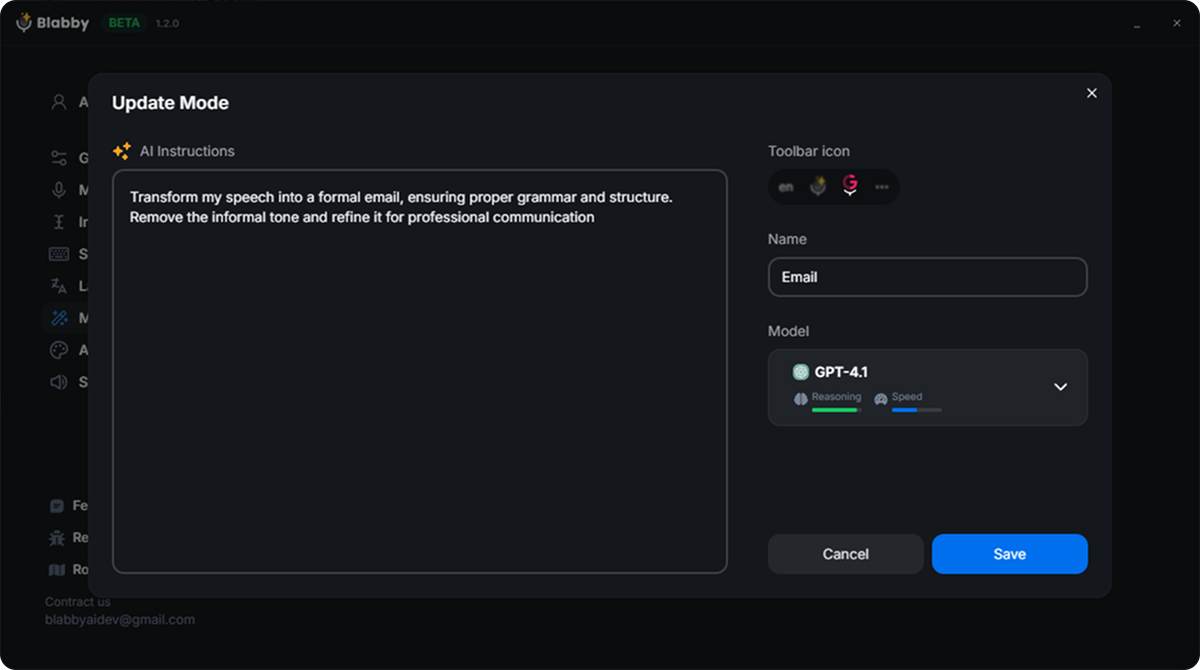
Price aside, there is one thing a general AI dictation tool does that clinical dictation software generally does not: it rewrites what you said before it lands in the text field. BlabbyAI calls these custom modes, and a mode is just a written instruction applied to whatever you dictated.
A clinician might keep three of them on separate shortcuts. One turns a rambling spoken summary into a structured referral letter. One strips filler and tightens a reply to a colleague. One takes a dictated paragraph and returns it in plain language suitable for a patient-facing message. You speak once, and what arrives is already the shape you wanted rather than a raw transcript you then spend four minutes editing.
Custom spelling is the other piece worth knowing about. Colleague names, referring practices, local drug brand names and the acronyms your department actually uses can be taught once and then spelled correctly every time. That is usually what makes or breaks whether dictation is faster than typing in practice, because a transcript you have to correct on every third proper noun is not saving anybody time.
A short way to decide
- Charting inside Epic or Cerner is the bulk of your dictation. Budget the full $1,713 first year per clinician, negotiate the term, and pair it with something cheaper for everything else.
- You want the note written for you from the patient conversation rather than dictated. Look at ambient scribes, not dictation software, before comparing prices.
- Most of your typing is correspondence, admin, referral letters and general writing. BlabbyAI covers all of it at $8.49 a month, with a free tier to test on your own work first.
- You already hold a clinical licence and it feels expensive for what you use it on. That usually means the licence is doing work it was never priced for. Keep it for charting, move the rest to BlabbyAI, and the two together still cost less than adding a second clinical seat.
For a wider comparison of clinical options, see our guide to the best medical dictation software, or the breakdown of how transcription, dictation, and AI scribes differ. For Dragon pricing outside healthcare, our Dragon dictation software guide covers the consumer and professional editions, and our dictation software overview compares the general-purpose tools.
Frequently asked questions
How much does Dragon Medical One cost?
Dragon Medical One costs $99 per user per month on a one-year term, $89 on a two-year term, and $79 on a three-year term, sold through authorized resellers rather than direct from Microsoft. On top of the subscription there is a one-time implementation fee of about $525 per user. That puts the true first-year cost at roughly $1,713 per clinician on the one-year plan, and about $1,188 in each following year.
Why is there no official Dragon Medical One price list?
Microsoft, which acquired Nuance in 2022, does not publish a price for Dragon Medical One on its product page. The software is sold through a reseller channel, and each reseller sets its own bundle, discount, and implementation package. That is why searching for the price returns a dozen different numbers: they are all real, they are just different resellers quoting different terms.
Is the $525 implementation fee mandatory?
In practice it is charged on almost every new single-provider subscription, and it covers account setup, user configuration, and basic training. Some resellers bundle it into a prepaid first-year price rather than listing it separately, and larger group practices negotiating multiple seats can sometimes get it reduced or waived. Treat it as a real line item when budgeting rather than an optional extra.
Does Dragon Medical One have a free trial?
Some authorized resellers list a 14-day trial, occasionally priced at a nominal $0.01 so it runs through their checkout. There is no permanent free tier and no one-time perpetual licence for Dragon Medical One, because it is a cloud subscription product. The older on-premise Dragon Medical Practice Edition was a one-time purchase, which is a large part of why the two get confused in cost comparisons.
Is Dragon Medical One worth the cost?
It earns the price when charting is the bulk of your dictation and you need specialty medical vocabulary plus voice navigation of fields and templates inside Epic or Cerner. That is what the enterprise band buys. What it does not cover is the rest of a clinical day: referral letters, replies to colleagues, admin forms, research notes and teaching material, which for most clinicians is the larger share of what they type. Running that through a $1,713-a-year licence is the most common way this budget gets stretched, and it is why many clinicians pair the clinical seat with a general dictation app like BlabbyAI at $8.49 a month.
How accurate is Dragon Medical One compared to cheaper dictation apps?
On clinical language it has a real edge, because it is trained on medical vocabulary and recognises drug names, anatomy and specialty terminology without you teaching them. On ordinary English the gap has largely closed: modern general-purpose speech models handle conversational dictation, punctuation and casing well, and BlabbyAI runs on Whisper large v3 turbo. For a referral letter or an email, recognition quality is not what separates them. In daily use accuracy is usually lost on names rather than hard clinical words, so the more useful question is whether a tool lets you teach spellings once instead of correcting the same word forever.
Can I buy Dragon Medical One as a one-time purchase?
No. Dragon Medical One is a cloud subscription and there is no perpetual licence, which is a common disappointment for solo practices that would rather buy software once. The confusion comes from Dragon Medical Practice Edition, the older on-premise product that was sold outright, whose pages are still indexed. If the recurring bill rather than the amount is the objection, note that cheaper tools in this category are also subscriptions, though some are far smaller: BlabbyAI is $8.49 a month and has a free tier of about 2,000 words a week with no card required.
Should I run Dragon Medical One and a cheaper dictation app together?
Many clinicians do, and the arithmetic is why. A clinical licence is priced around the encounter note, but charting is rarely more than half of what a clinician types in a day. Referral letters, replies to colleagues, prior authorisation notes, patient messages, teaching material and admin forms all need clean text rather than specialty vocabulary or template navigation. A year of BlabbyAI is $101.88, under three weeks of a single Dragon seat, so pairing the two adds roughly six percent to the cost and covers the larger half of the typing day.
What is the difference between Dragon Medical One and Dragon Medical Practice Edition?
Dragon Medical One is the current cloud subscription, billed per user per month with a setup fee. Dragon Medical Practice Edition was the older on-premise version bought once outright, with paid version upgrades every few years. Practice Edition is why you will still find pages saying there are no monthly fees. For a new buyer in 2026 the cloud subscription is the product actually being sold.
Are there cheaper alternatives to Dragon Medical One?
Yes, and they split by what work you are doing. Ambient AI scribes like Freed and Abridge sit in a similar price band and generate a note from the patient conversation instead of taking dictation. For everything outside the chart note, which is most of what a clinician types, BlabbyAI costs $8.49 a month with a free tier, runs on Windows, and types your speech into any application including a browser-based EHR text field. Windows also has free built-in voice typing on Windows key + H, though with no medical vocabulary and no formatting.
Not every sentence you dictate is a clinical note
BlabbyAI: system-wide AI dictation on Windows for $8.49 a month. 2,000 words a week free, no card.